


 |
Automotive-Grade Encapsulated Alloy Resistor automotive-grade alloy
Product Details:
| Place of Origin: | Dongguan,Guangdong,China |
| Brand Name: | UCHI |
| Model Number: | UL.VDE,SGS,REACH,CQC,CSA.ISO.ROHS,CUL |
Payment & Shipping Terms:
| Minimum Order Quantity: | 5000PCS |
|---|---|
| Price: | Negotiable |
| Packaging Details: | Bulk/Ammo/Reel |
| Delivery Time: | 5-7 days |
| Payment Terms: | T/T,Paypal,Western Union, |
| Supply Ability: | 5000,000,000PCS Per Month |
|
Detail Information |
|||
| Max Capacitance: | 250pF | Termination Style: | Radial |
|---|---|---|---|
| Vac: | 460V | Storage Temperature: | -40~+85℃ |
| Resistance Value: | 5 Ohm | Breakdown Time: | <50ns |
| Tolerance: | ±5% To ±20% | Technology: | Carbon Film |
| Sample Leadtime: | 1-2 Days | Aging Rate: | ≤1% |
| Current: | 3KA | Product Model: | Metal Oxide Varistor |
| Body: | ZNO | Dissipation Factor: | ≤0.2 |
| Media Available: | Datasheet, Photo | ||
| Highlight: | automotive-grade alloy resistor,encapsulated alloy resistor,metal oxide varistor resistor |
||
Product Description
Automotive-Grade Encapsulated Alloy Resistor
(also known as automotive-grade alloy current-sensing / shunt resistor. Encapsulation refers to the process of fully covering and protecting the resistive element with high thermal conductivity epoxy or similar materials.)
It is a key component for current sensing in automotive electronics and must pass AEC-Q200 qualification and comply with IATF16949 supply chain control requirements.
Core Definition & Structure
Materials:
Resistive element is usually made of manganin, nichrome, constantan or other alloys (low temperature coefficient, high stability).
Encapsulation: fully encapsulated with high thermal conductivity epoxy resin.
Terminals: often Ag-Pd alloy for anti-sulfur performance.
Some high-end models adopt 4-terminal (Kelvin connection) to improve sensing accuracy.
Process:
Precision machining of alloy foil / sheet → laser trimming → encapsulation molding → terminal plating → 100% inspection.
Compared with bare alloy resistors, encapsulated devices have better moisture resistance, vibration resistance, corrosion resistance and soldering consistency.
Automotive Requirements:
Must pass AEC-Q200 tests (temperature cycling, thermal shock, vibration, humidity, solder heat resistance, etc.).
Operating temperature: typically -55℃ ~ 170℃.
Moisture sensitivity level: MSL 1.
Compliant with RoHS and halogen-free standards.
Key Electrical Characteristics
表格
| Parameter | Typical Range | Meaning |
|---|---|---|
| Resistance | 0.1 mΩ ~ 100 mΩ | Milliohm level, suitable for high-current shunt sensing |
| TCR (Temperature Coefficient) | ±10 ~ ±50 ppm/℃ | Much better than thick-film resistors; stable accuracy over wide temperature |
| Tolerance | ±0.5% / ±1% | Basic accuracy guarantee for current sensing |
| Power Rating | 1 W ~ 15 W (2512: ~3–6 W; 5931: up to 15 W) | Determines maximum sustainable current |
| Parasitic Inductance | <5 nH | Reduces interference in high-frequency / fast-charging applications |
Typical Applications
- New Energy Vehicles:
Current sensing for BMS (Battery Management System), OBC (On-Board Charger), DC/DC converters, motor controllers.
- Conventional Vehicles:
Engine ECU, ABS/ESP, lighting power supply, transmission control.
- Charging Equipment:
Power detection in charging stations / piles.
Main Brands & Models
- International:
Vishay WSL/WSK, Panasonic ERJ, ROHM LRM.
- Domestic:
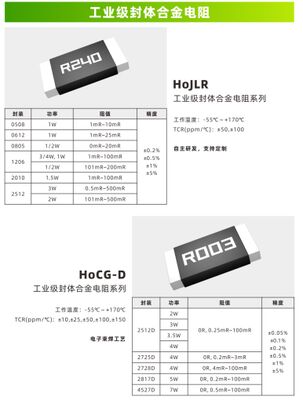
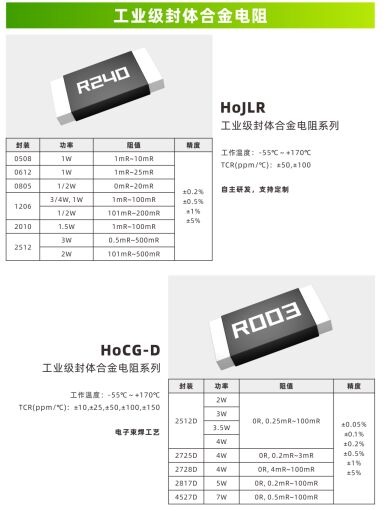
Fenghua AMG/AMS, Huade MSU/MSHL, HoYao HoCG2512.
Electronic Component: Vishay WSL Automotive-Grade Alloy Resistor
Selection Guidelines
- Calculate power using P = I²R and apply ≥30% derating (mandatory in high-temperature environments).
- Prefer 4-terminal (Kelvin) structure for μΩ-level high-precision sensing.
- For high anti-sulfur / anti-vibration requirements, confirm coating process (e.g. ALD Al₂O₃) and terminal material.
- Must obtain AEC-Q200 test reports and IATF16949 certification.
Difference from Standard Alloy Resistors
Standard alloy resistors are usually bare or semi-encapsulated, with weak moisture resistance, anti-sulfur performance and mechanical shock resistance.
Automotive-grade encapsulated products feature full encapsulation + full automotive qualification + full supply chain traceability, with significantly higher long-term reliability.
They cannot be replaced in vehicle safety-related circuits.
Industrial-Grade Encapsulated Alloy Resistor
Systematic overview of industrial-grade encapsulated alloy resistors (fully epoxy-encapsulated current-sensing resistors for industrial automation, power supplies, energy storage, inverters, etc., complying with industrial reliability standards, different from automotive products requiring mandatory AEC-Q200).
1. Core Definition & Structure
Materials & Construction:
Resistive element: manganin, constantan, nichrome alloy foil / sheet (low TCR, high stability).
Fully encapsulated with high thermal conductivity epoxy to isolate dust, moisture and chemical corrosion.
Terminals: usually tin-plated / Ag-Pd for anti-sulfur performance.
4-terminal (Kelvin) structure for μΩ-level high-precision sensing.
Process:
Alloy precision etching → laser trimming → epoxy molding encapsulation → terminal plating → 100% electrical & reliability screening.
Encapsulated structure provides better vibration resistance, moisture resistance and soldering consistency than bare alloy.
Industrial Requirements:
Operating temperature:
- Standard: -40℃ ~ 125℃
- High-temperature types: -55℃ ~ 170℃
Moisture sensitivity level: MSL 1.Compliant with RoHS / halogen-free.Reliability tests per JESD47, IEC 60068 (temperature cycling, thermal shock, vibration, humidity, solder heat resistance).Quality system: mostly ISO9001; high-end lines also support IATF16949.AEC-Q200 is not mandatory (can be customized upon request).
2. Key Electrical Characteristics (Typical)
表格
| Parameter | Typical Range | Meaning for Industrial Use |
|---|---|---|
| Resistance | 0.1 mΩ ~ 100 mΩ (mainly milliohm level) | High-current shunt, low voltage drop & low loss |
| TCR | ±10 ~ ±50 ppm/℃ | Stable sensing accuracy over wide temperature, better than thick-film |
| Tolerance | ±0.5% / ±1% (precision line: ±0.1%) | For closed-loop control in servo drives & power supplies |
| Power Rating | 1 W ~ 15 W (2512: ~3–6 W; 5931: up to 15 W) | Determines max current based on package & cooling |
| Parasitic Inductance | <5 nH | Reduces interference in high-frequency SMPS & inverter drives |
| Rated Temperature | 125℃ (standard) / 155℃ / 170℃ (power type) | Withstands high internal temperature in control cabinets / power modules |
3. Typical Applications
- Industrial Power:
Current sensing & overcurrent protection for UPS, switching power supplies, inverters, DC/DC modules.
- Automation & Drives:
Servo drives, PLC, robot controllers.
- New Energy & Energy Storage:
Energy storage PCS, PV inverters, charging station modules.
- Telecom Equipment:
Base station power supplies, data center server power supplies.
4. Main Brands & Models
- International:
Vishay WSL2512, Panasonic ERJ‑8EN, KOA Speer RK731.
- Domestic:
Fenghua AMG/AMS, HoYao HoCG2512, FOSAN FMH, Huade MSU.
5. Core Selection Steps
- Calculate rated current using
Apply power derating: ≤70% (≤50% recommended in high temperature).
- Accuracy & TCR:
- Precision current loop: ±0.5% / ±10~25 ppm/℃
- General protection loop: ±1% / ±50 ppm/℃
- Package & mounting:
2512 / 3920 / 5931 are common in industry.Reserve thermal pads on PCB.4-terminal preferred for high-precision sensing below 1 mΩ.
- Environment:
For humid / coastal / sulfur-containing environments, choose anti-sulfur terminals + full encapsulation.For high-vibration equipment, confirm vibration resistance and mounting method.
6. Industrial vs Automotive-Grade Encapsulated Alloy Resistor
表格
| Dimension | Industrial-Grade | Automotive-Grade (AEC-Q200) |
|---|---|---|
| Standards & Certification | JESD47, IEC 60068; AEC-Q200 not mandatory | Must pass AEC-Q200; IATF16949 mandatory |
| Temperature Range | Standard: -40℃~125℃; High-end: -55℃~170℃ | Universal: -55℃~170℃ for engine bay / battery pack |
| Reliability Testing | Lower cycle counts & stress levels | Much stricter: temperature cycling, thermal shock, humidity, vibration |
| Cost & Lead Time | Cost-effective, flexible lead time | Higher cost, strict supply chain control, longer lead time |
| Application | Industrial automation, power, energy storage | NEV BMS, OBC, motor controllers and other vehicle safety-related circuits |
7. Purchasing & Verification Points
- Obtain complete datasheet + reliability test reports (temperature cycling, humidity, solder heat resistance data).
- Confirm RoHS, halogen-free compliance. Anti-sulfur requirements must be specified and tested separately.
- Power derating curve must match actual PCB thermal conditions to avoid long-term overheating failure.
Want to Know more details about this product
