


 |
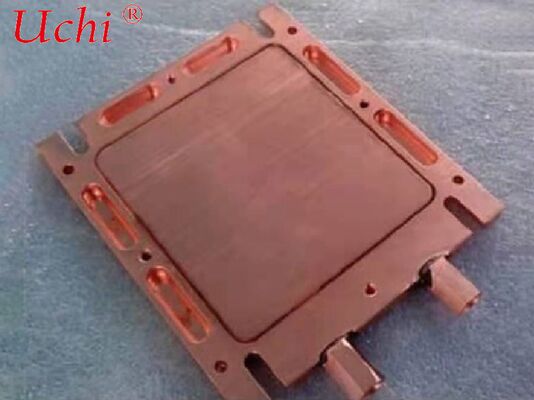
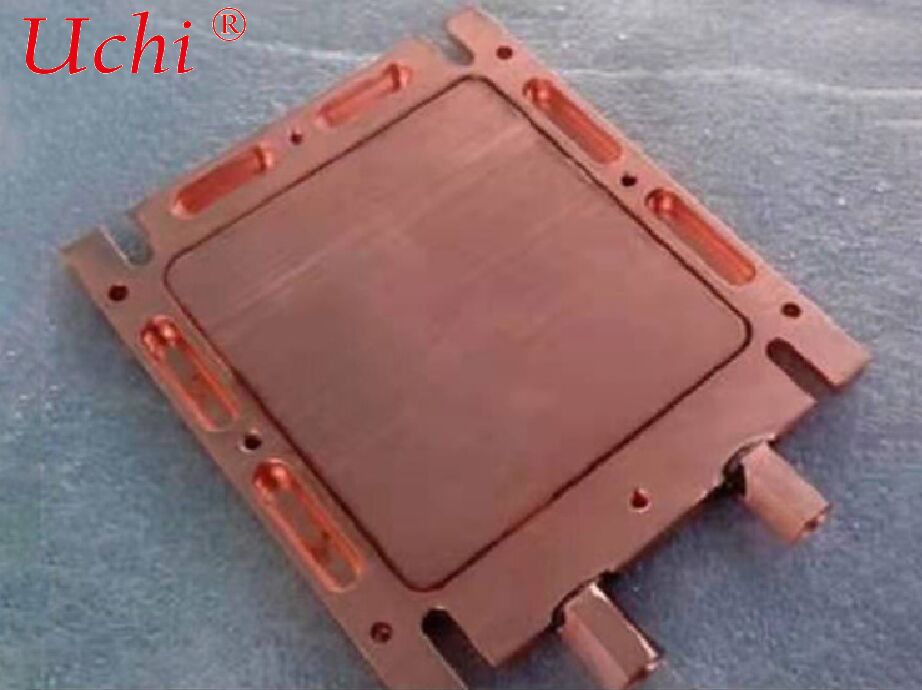
Micro-Channel Liquid Cooling Plate (MLCP) High-Heat-Flux Electronic Devices
Product Details:
| Place of Origin: | Dongguan,Guangdong,China |
| Brand Name: | Uchi |
| Certification: | SMC |
| Model Number: | Heat Sink |
Payment & Shipping Terms:
| Minimum Order Quantity: | 100pcs |
|---|---|
| Price: | 1300-1500 dollars |
| Delivery Time: | not limited |
| Payment Terms: | T/T,paypal, Western Union, |
| Supply Ability: | 50000000pcs per Month |
|
Detail Information |
|||
| Deep Process: | CNC Machining | Dimensions: | Customizable (e.g., 100mm X 100mm X 10mm) |
|---|---|---|---|
| Surface Treatment: | Oil Cleaning And Anti-oxidation | Packing: | PE Bag Carton |
| Keyword: | CNC Macining Parts | Tolerance: | ±1% |
| Conducting Power: | 500 W | Surface Finish: | Mill Finish Or Anodization |
| Texture Of Material: | 6061 | Thickness: | 7mm |
| Service: | OEM Service | ||
| Highlight: | Micro-Channel Liquid Cooling Plate for electronics,High-Heat-Flux Liquid Cooling Plate,MLCP cooling plate for high-heat devices |
||
Product Description
Micro-Channel Liquid Cooling Plate (MLCP)
Micro-Channel Liquid Cooling Plate (MLCP) is an ultimate thermal solution for high-heat-flux electronic devices. Its core lies in the integrated dense array of micro flow channels with a hydraulic diameter typically ≤1mm (often 50–500μm), which greatly increases heat exchange area and efficiency, distinguishing it from conventional water cooling plates with millimeter-scale flow channels.
1. Definition and Core Structure
Definition:
MLCP utilizes precision processes to fabricate micron-scale flow channels inside high-thermal-conductivity substrates. Cooling liquid undergoes forced convection within the channels, realizing close-range / direct heat transfer between heat sources and coolant. With densely arranged flow channels, its heat exchange area per unit area is 3–10 times that of traditional cooling plates. It can be integrated with chip packaging to shorten the heat transfer path.
Core Components
- Substrate: Oxygen-free copper (best thermal conductivity, high cost), 6061/6063 aluminum alloy (cost-effective), silicon (semiconductor etching, suitable for chip-level integration);
- Micro flow channel array: Straight, serpentine, parallel, or fractal channels, often equipped with microfins / ribs;
- Sealing cover plate sealed via friction stir welding (FSW), diffusion bonding, or vacuum brazing;
- Liquid inlet & outlet ports (G1/4, NPT), sealed with O-rings or welding;
- Surface treatment: Anodizing, nickel plating, conductive oxidation for installation and corrosion resistance.
2. Working Principle
The cooling plate is tightly attached to heat sources (AI chips, laser pump sources) via thermal grease or phase change materials.
Heat is rapidly conducted to the microchannel walls.
Deionized water or ethylene glycol solution flows at high speed inside the microchannels. The thin thermal boundary layer significantly reduces thermal resistance, delivering extremely high convective heat transfer efficiency.
The heated fluid returns to a chiller or CDU for cooling, forming a closed loop.
Integrated MLCP can embed flow channels within the package, achieving a short heat transfer path “from chip to coolant”, with thermal resistance reduced to the level of 0.03℃·cm²/W.
3. Mainstream Manufacturing Processes
- Precision etching + diffusion bonding / FSW: Micro grooves formed by photolithography and etching on silicon / copper substrates, sealed with solid-state welding; suitable for ultra-fine channels (50–100μm);
- Embedded microtubes + vacuum brazing: Array of ultra-fine copper tubes embedded in the substrate, with gaps filled by brazing;
- Metal 3D printing (SLM): Direct forming of complex flow channels, ideal for small-batch customization;
- Chemical etching + laser welding: Suitable for thin cooling plates, balancing precision and cost.
4. Performance Advantages and Comparison (vs. Conventional Water Cooling Plates)
| Comparison Item | Micro-Channel Liquid Cooling Plate (MLCP) | Conventional Water Cooling Plate (mm-scale channels) |
|---|---|---|
| Channel Size | 50–500μm, dense array | 1–6mm, sparse serpentine / parallel channels |
| Heat Exchange Area | 3–10 times higher per unit area | Basic area without dense enhancement |
| Heat Flux Capacity | Over 1000W/cm², supports 2000W+ single chip | ≤300W/cm², difficult for ultra-high power |
| Thermal Resistance | Extremely low (0.03–0.1℃·cm²/W) | Relatively high (0.2–0.5℃·cm²/W) |
| Temperature Uniformity | Excellent, no local hot spots | Average, large temperature difference between edge and center |
| Cost | High R&D and manufacturing cost, for high-end applications | Low cost, mature mass production |
5. Key Technical Parameters
- Channel parameters: Width 50–500μm, depth 200–800μm, spacing 100–300μm;
- Flow rate & pressure drop: Flow velocity 2–5m/s, operating pressure 0.5–1.5MPa, pressure drop controlled within 0.3MPa;
- Material thermal conductivity: Copper 386W/m·K, aluminum alloy 205W/m·K;
- Sealing performance: Helium leak rate ≤1×10⁻⁹ mbar·L/s;
- Surface flatness: ≤0.05mm/100mm.
6. Typical Application Scenarios
- AI servers and computing chips: NVIDIA Rubin GPU, high-end CPUs, AI accelerator cards with 1500–2300W single-chip power consumption;
- High-power fiber lasers: Pump modules, beam combiners, resonant cavities;
- Semiconductor manufacturing: Laser annealing, etching equipment;
- Medical equipment: High-power laser therapeutic instruments.
7. Selection and Maintenance Guidelines
- Selection: Determine channel density and material based on heat flux; select thickness according to space constraints; confirm port specifications and coolant compatibility;
- Maintenance: Deionized water (conductivity < 1μS/cm) is mandatory; replace coolant every 6–12 months to prevent scaling; perform pressure and helium leak tests annually; avoid severe impact to prevent channel deformation.
8. Technology Trends
- Deep integration with chip packaging (Chiplet + MLCP);
- Two-phase cooling (boiling inside microchannels) for further efficiency improvement;
- Breakthroughs in low-cost manufacturing processes to promote adoption in mid-range computing equipment.
Want to Know more details about this product
