


 |
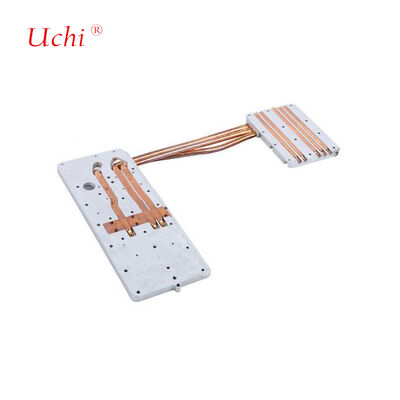
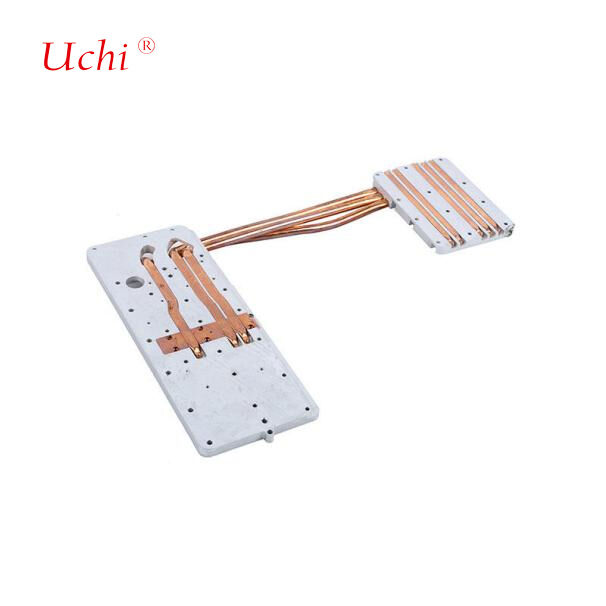
Super Calculator Water Cooling Plate Microchannel Liquid Cooling Plate
Product Details:
| Place of Origin: | Dongguan,Guangdong,China |
| Brand Name: | Uchi |
| Certification: | SMC |
| Model Number: | Heat Sink |
Payment & Shipping Terms:
| Minimum Order Quantity: | 100pcs |
|---|---|
| Price: | 1300-1500 dollars |
| Delivery Time: | not limited |
| Payment Terms: | T/T,paypal, Western Union, |
| Supply Ability: | 50000000pcs per Month |
|
Detail Information |
|||
| Highlight: | microchannel liquid cooling plate,water cooling plate for calculators,liquid cooling plate with microchannels |
||
|---|---|---|---|
Product Description
Core Definition & Working Principle
A water cooling plate for supercomputers is a metal heat exchange component mounted directly onto high-heat-flux chips such as CPUs and GPUs. It contains precision internal flow channels, which rapidly remove heat from the chips using circulating deionized water or specialized coolant. Heat is then dissipated through a CDU (Coolant Distribution Unit) and outdoor dry coolers, forming a closed-loop cooling system.
Compared with air cooling, water cooling plates increase heat flux density by 5–8 times, raising cabinet power density from approximately 15 kW for air cooling to over 50 kW. The PUE (Power Usage Effectiveness) can be reduced to 1.05–1.1, significantly lowering data center energy consumption.
High-performance thermal grease or phase change materials (TIM) must be applied to the contact interface. Fixtures ensure a contact ratio above 95%, controlling thermal resistance to ≤0.05 °C/W.
Main Structures & Manufacturing Processes
- Skived fin / microchannel cooling plates (mainstream for supercomputers): 0.1–1 mm microchannels or fins are precision-machined or etched on copper or aluminum substrates. They feature large heat exchange areas and low thermal resistance (down to 0.02 °C/W). MLCP (Microchannel Cooling Plate Integrated Package) further integrates the cooling plate with the chip IHS, eliminating the intermediate TIM layer and reducing thermal resistance by more than 40%, suitable for 1500–2000 W GPUs/CPUs.
- Tube-embedded cooling plates: Copper tubes are embedded into milled grooves on the base plate and sealed by welding. Costs are about 30% lower than microchannel types, making them suitable for medium-to-high power general nodes, though with slightly higher local thermal resistance.
- 3D-printed cooling plates: Produced via SLM technology using copper alloys with topology-optimized flow channels. Complex channels can be customized, improving heat dissipation efficiency by 30%, but high mass-production costs limit use to customized supercomputer components.
- Blown / extruded cooling plates: Low cost and high production speed, but limited thermal performance; generally not used for core computing chips.
Key Technical Specifications & System Support
- Materials: Copper (thermal conductivity 401 W/(m·K), preferred for heat exchange), aluminum (lightweight and low-cost for auxiliary components). High-end models use copper‑tungsten alloys to balance thermal conductivity and coefficient of thermal expansion.
- Sealing & safety: Dual O‑rings + vacuum brazing, leakage rate < 10⁻⁶ mL/h. Equipped with pressure / liquid leakage sensors and automatic shut-off valves.
- Coolants: Deionized water (low cost, high specific heat capacity), water‑glycol (antifreeze), electronic fluorinated fluid (insulating, for leak‑sensitive applications).
- CDU & control: Temperature control accuracy ±0.5 °C, adjustable flow rate to avoid excessive temperature differences between chips.
- Thermal performance: Heat flux density up to 100 W/cm²+, chip surface temperature difference < 5 °C.
Typical Supercomputer Applications
- Summit / Sierra (Oak Ridge / Lawrence Livermore National Laboratory, USA): Adopt hybrid cooling with direct cooling for all CPUs and GPUs. Cooling plates handle 90% of the heat load. Cooling water temperature exceeds 40 °C, greatly reducing system energy consumption.
- New-generation domestic exascale supercomputers (e.g., follow-up models of Sunway, Tianhe): Widely use cold plate liquid cooling. Some adopt MLCP and two-phase cooling (boiling heat absorption of phase-change fluids), further improving cooling efficiency and reducing pump power consumption by 30%–60%.
Challenges & Development Trends
- Cost & manufacturing: Microchannels and MLCP require extremely high machining precision, and yield directly affects cost.
- Maintenance: Long-term operation requires high coolant purity and clean pipelines to prevent corrosion and fouling.
- Trends: Integration of cooling plates and chip packaging, two-phase cooling, hybrid immersion + cold plate solutions, and AI‑based predictive control for CDU flow and temperature.
Want to Know more details about this product
